








Luigia Gio Martelloni: The Forest of Then & Now
Call it conceptual nostalgia for the present. Or allegorical landscape history. Or diaristic arboreal cartography. What photographer, painter, sculptor, filmmaker, and installation artist Luigia Gio Martelloni pursues, across and in-between an array of studio mediums, is a unique hybrid of academic training, personal impulses, and formal influences that run the gamut from Old Master painting to Neorealist cinema and the poetic found-object innovations of the post-War poveristas.
Her totemic go-to is the world of trees of all species, which she views as emblems of specific places she has been, where life events of deep significance and captivating fleeting moments transpired. She does not anthropomorphize the trees as is familiar in the parlance of painting and poetry; rather they serve as markers that transcend time to trigger memories in a Proustian language known only to herself. Yet despite the inscrutability of her private narrative, the operatic vernacular energy of her work communicates in an almost metaphysical sense that the viewer is free to use the work to remember their own stories; there's plenty of room in her deliberate and esoteric pictorials for everyone's consciousness to take root.
Her aesthetic is both breezy and grounded, with black, white and earth tones predominant, an affection for negative space and projected shadow, and the inclusion of flamboyant objects from nature, especially chopped wood, dried branches, fronds, and bark -- pieces from the literal world invited back into the discourse alongside their own depictions. These juxtapositions are graceful and awkward, unexpected but accessible attempts to shift the quality of the viewer's attention to include original direct experience in their interpretation of the imagery. In Breathing, which is both an exhibition and an installation design, a singular whole and an orchestration of parts, Martelloni offers multiple material pathways into her thought process, involving by turns all her strategies of art-making.
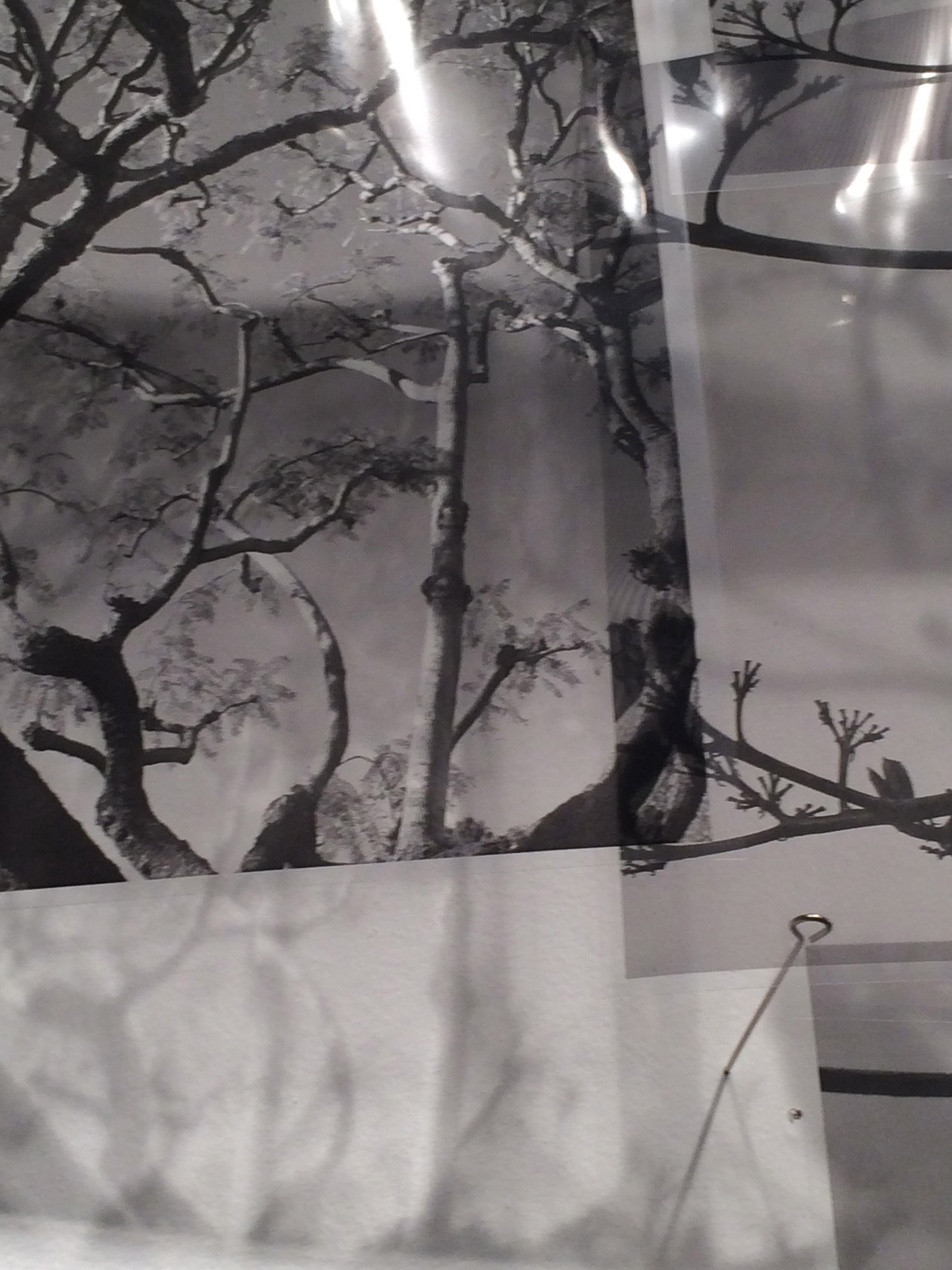
The eponymous installation Breathing (2015) is a splay of 150 black and white photographs on transparency plus a projected video. Taken as a single installation, the photography has a certain fractal balance that feels like an organic randomness, but in fact is mapped out and installed in a specific order designed to highlight occasional correspondences between groups of two, three, or several frames, and evoke the overall design of a sprawling tree in its intuitive armature. Trees in this array come from various species, evergreen to deciduous, blooming or barren, silhouetted against the sky or seen in close-up detail. The video was shot on film, with no post-production, its audible projection equipment and elusive soundtrack of footsteps, and its analog frame rate creating a lightly percussive, flickering light and sound experience that echoes the breeze and flutter of the prints fluttering gently off the wall. It shows the dappled light of sun filtered through leafy treetops. It contains no narrative yet retains the emotional impact of the place where it accesses the collective subconscious.
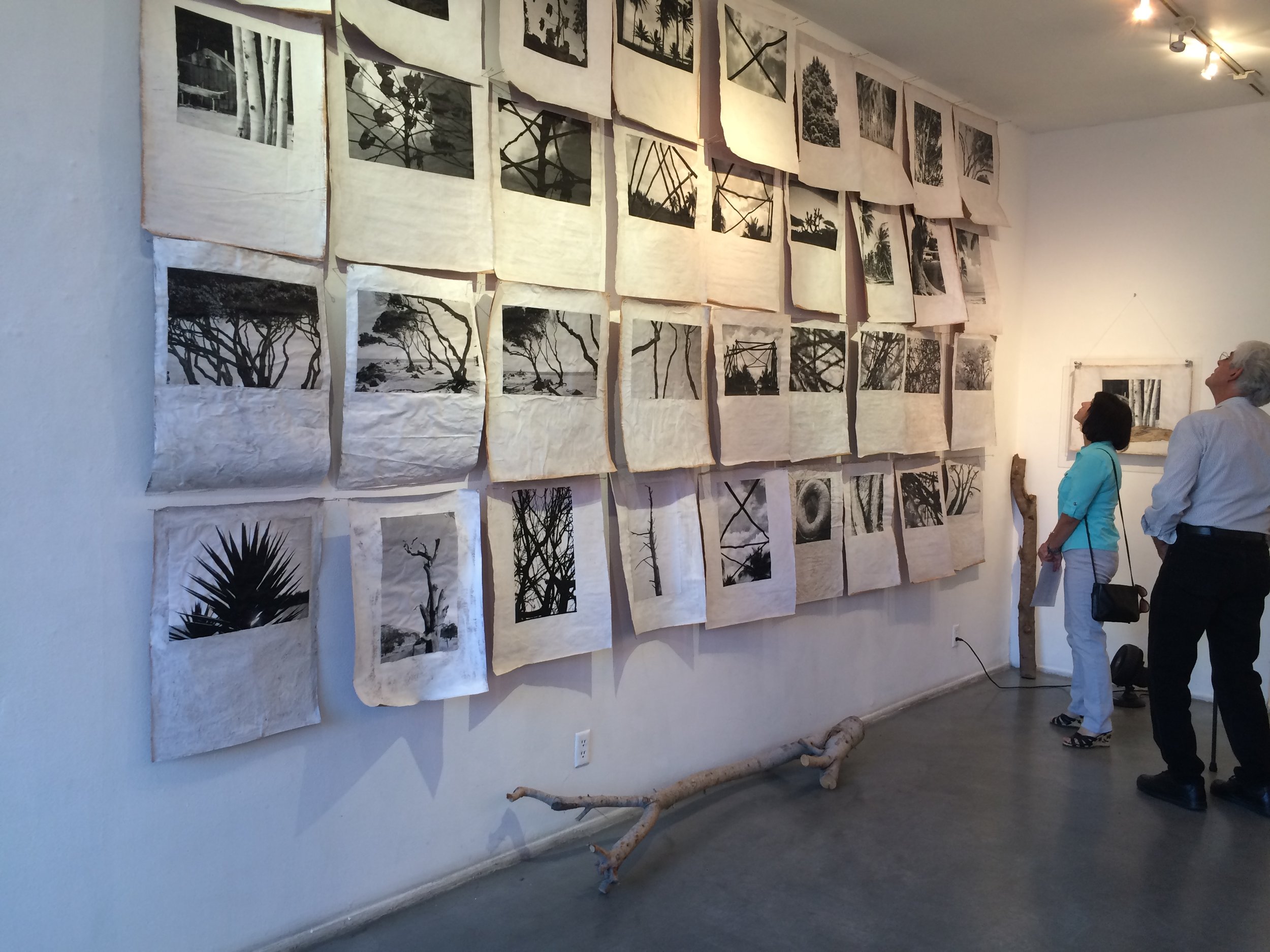
Traces (2009-2016) is a grid of 24 x 20 black and white unique painted prints on paper, referencing the modernist minimal tradition of monochrome painting. Like the transparencies in Breathing, they are hung pinned rather than framed, so that they sway and rustle within their breeze-tussled grid. All of them are selections from the same archive as Breathing, but the larger scale and opaque, tactile chalk and ink object quality of the prints themselves gives a far more physical, ancient, tactile perspective on the same content. This impulse for extreme tactility is evocative of Anselm Kiefer with his straw, Walter de Maria with his patches of fragrant earth, and Andy Goldsworthy with his aesthetic interpretations and direct material appropriations of Nature.
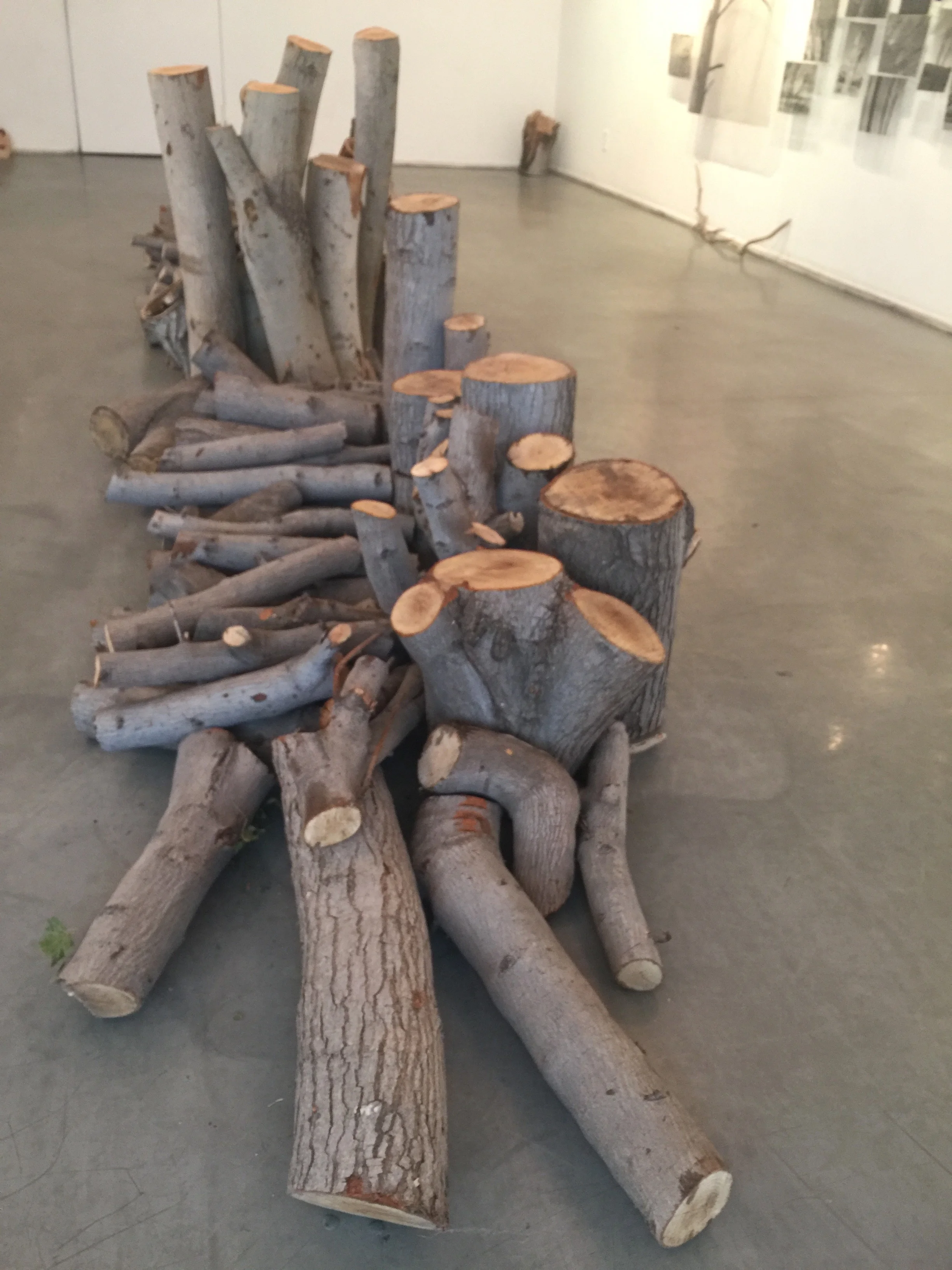
Works like Not Just a House, Fragile Beauty, Along the River, Castore & Polluce, and Stand Up Memory -- these are all works that incorporate branches, peeled bark, paper as a ground even in large scale and other like materials that sustain the overall metaphorical motif of evolution, revolution, and continual transformation within and between the humanity/nature continuum. In the tree-size Castore & Polluce in particular, her use of paper and bark -- really two manifestations of the same element, harvested and modified -- both depicts and embodies this dynamic. Martelloni frequently further incorporates chopped wood, along with collected crystals and mineral stones, ceramics, and meaningful talismanic found objects into her dimensional compositions. In works like Stand Up Memory, the entirety of the intimately monumental sculptural arrangement is made from recently collected and chopped fresh, young wood. It is both a melancholia of the living and a memento for the dead; it is an aromatic, tactile, serenely visceral contemplation on revolving stages of existence; it is a piece of transitory sculpture whose emotional impact comes both from its physical actuality and its enduringly esoteric metaphorics. Contemplating the whole of Martelloni's scope of investigation, one gets the sense that this cyclical journaling could manifest itself forever; after all, trees outlive humans by centuries, and keep their own infinite secrets.
Luigia Gio Martelloni: The Forest of Then & Now / HaffPost by Shana Nys Dambrot
Read The Article
RESPIRI CALLIGRAFICI
by Patrizia Mania
(art historian/critic)
A diaphanous wall is layered with transparent sheets on which calligrams are inscribed, an intensely personal reflection of the artist, but one that everyone can feel. Breathing by Luigia Martelloni is made up of multiple images of a wide variety of tree species, run across over thirty years of roaming and wandering throughout the world, while their shadows are projected dynamically, cast off at some distance in the background.
Images of trees with thick foliage intertwining amid branches and shadows, in composited layers that overlap with neighboring trees, fragments abutting one another, creating a sense of both physical and formal assonance by the artist. They seem to almost function as "symbols", as if the lungs of our planet, set against a fragile, highly evocative and poeticlandscape.
This delicate expanse of arboreal imagery collected over time elegantly expresses the unique path of this artist, whose creative roots, while planted solidly in the poetry of the poverista movement, also convey with a documentary style her own experiences of the world. What is being described with this work is not a single episode or event, but a series of reflections on a theme which has compelled Luigia Martelloni to focus her attention consistently on nature, or specifically its landscapes and its elements, which then function as a kind of universal alphabet with stories to spell out that compel us to similar emotional responses.
While there are many methods used by today's contemporary artists, in the case of Luigia Martelloni we find ourselves faced with a powerful drive toward the documentation of existence, and while it reflects her own, is also one we all share, and it is in this very search for reciprocity that the relation between the work and its audience knitstogether.
The artist frequently sets branches and pieces of wood of varying coarseness among snippets of photographs or painted images. Black and white photos printed on transparent paper play a significant role, and both the natural elements as well as the images elicited seem to be treated as objets d'affections sentimentales. Whether an image or a fragment of nature itself, the artist has re-appropriated it in order to imbue it with new life.
The result is literally a flood of symbols that individually and woven together create an extraordinary scene that communicates both mutable consistency and hints of coexistence, as if the artist insists that we understand, by offering us a landscape, which rather than being a subjective vision, with its own ductus operandi extends to and belongs to all of us. In this light, Breathing, like the cycle of life itself, delivers through its imagery and dynamic projections the crystallization and transferal of the sense of a true poetic experience.