Elemental Earth: The Loft at Liz’s Gallery
THE JOURNEY BACK TO EARTH












THE JOURNEY BACK TO EARTH
by Linda Dzhema
In the beginning there was a map - a signifier of a journey, a promise of experience, a vastness of earth that yearned to be explored. Its cracks, its space, its character, infused with its moods, its promises, its alchemy - it beckoned to be walked, touched, breathed, felt. The vastness of the American territory, of course already experienced by generations, has offered many its knowledge and potential, but its spirit, it revealed only to those who sought to seek it.
Year 1986.
Accompanied only by the rhythmic revolution of the wheels carrying her through the expansive territory, Luigia Martelloni, a young accomplished Italian artist, embarked on her beginnings in North America. Bringing her longstanding academic inquiry into the Modernist Primitivism, along with its accorded importance to Jungian symbolism of the collective unconscious, the journey's focus came to naturally rest on indigenous Native American traditions and occult practices that framed understanding of the land's natural energy pathways. The exploration of esoteric, symbolic codices and the language of numbers implored by the native traditions, in turn, began to reveal an intimate vision of Earth to the journeying artist, inspiring a life-long relationship with the soul of the land.
Walking a fine balance between concept and objectivity, between what has been, what is and will be, The Journey Back to Earth installation presents artist's personal context in order to evoke new subjective associations for the many. With ritualistic gusto, Martelloni, transforms the exhibition space into a place of experience, creating an environment for the audiences to rediscover their own connection with the psyche of Earth. Staying true to her roots in the Italian avant-garde Arte Povera movement, her artistic lexicon purposefully discounts the product-in- duced comatose of contemporary culture in favor of organic materials and found objects with which she wields us back into locality of our own nature-selves. From here, we take the journey.
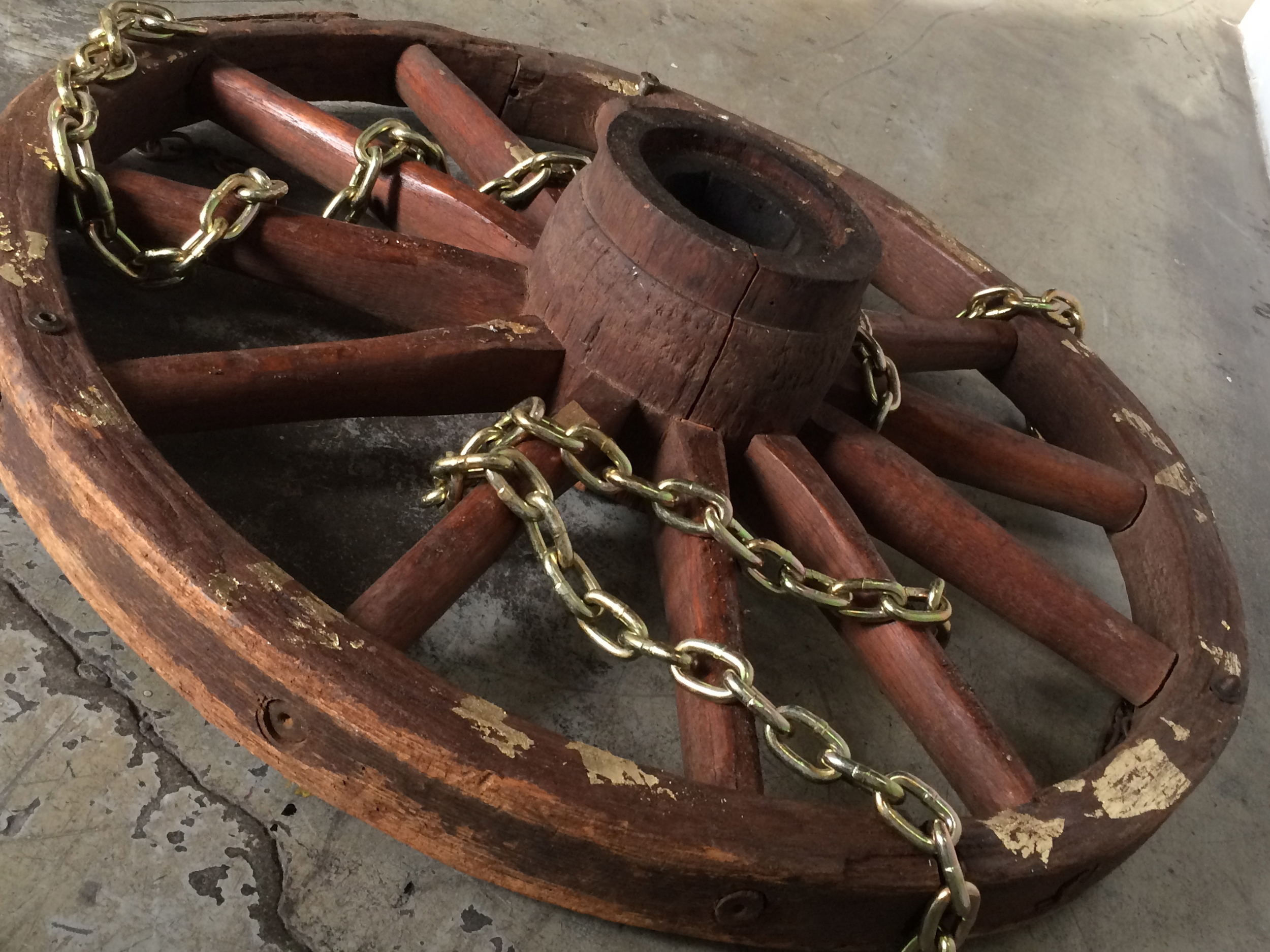
Setting in motion a clockwise exhibition narrative, the introduction of the primitive wheel along with the seriality of its spokes, evoke its rhythmic beat upon the earth, priming our attention with the connotation of cyclicality. The sincere simplicity of the worn found object, summons the te-dious burden of its repeated revolutions, invoking one of mankind's early inventions. Amid these recollections the artist coyly calls for a contemplation of balance between industry and nature through an allusion to one of mankind's early downfalls - it's lust for gold.
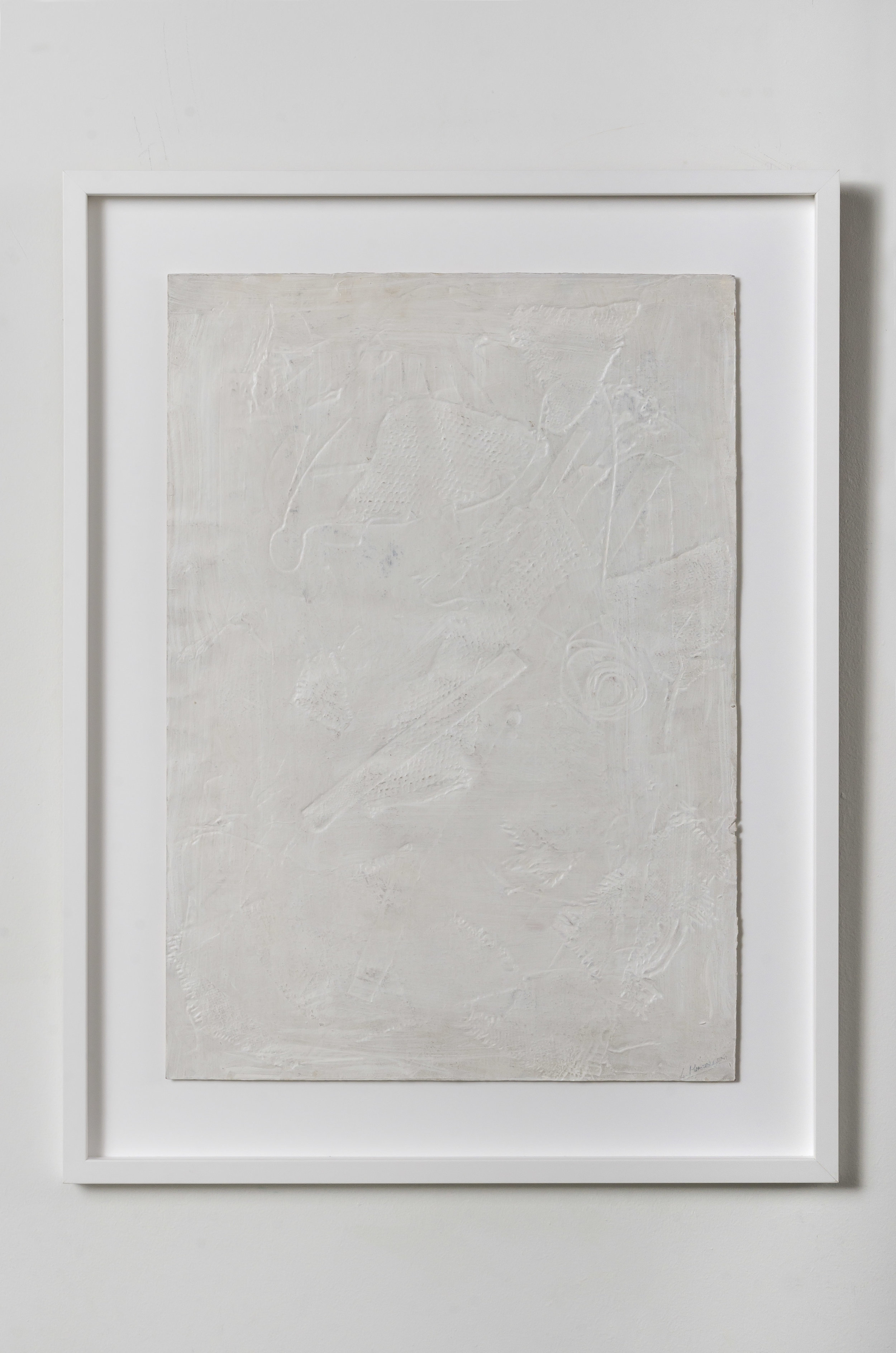
In continuing the homage paid to ingenuity of human endeavors, hang a series of collagraph mono prints. The materiality of the paper triptych harmoniously fuses notions of manmade and natural.
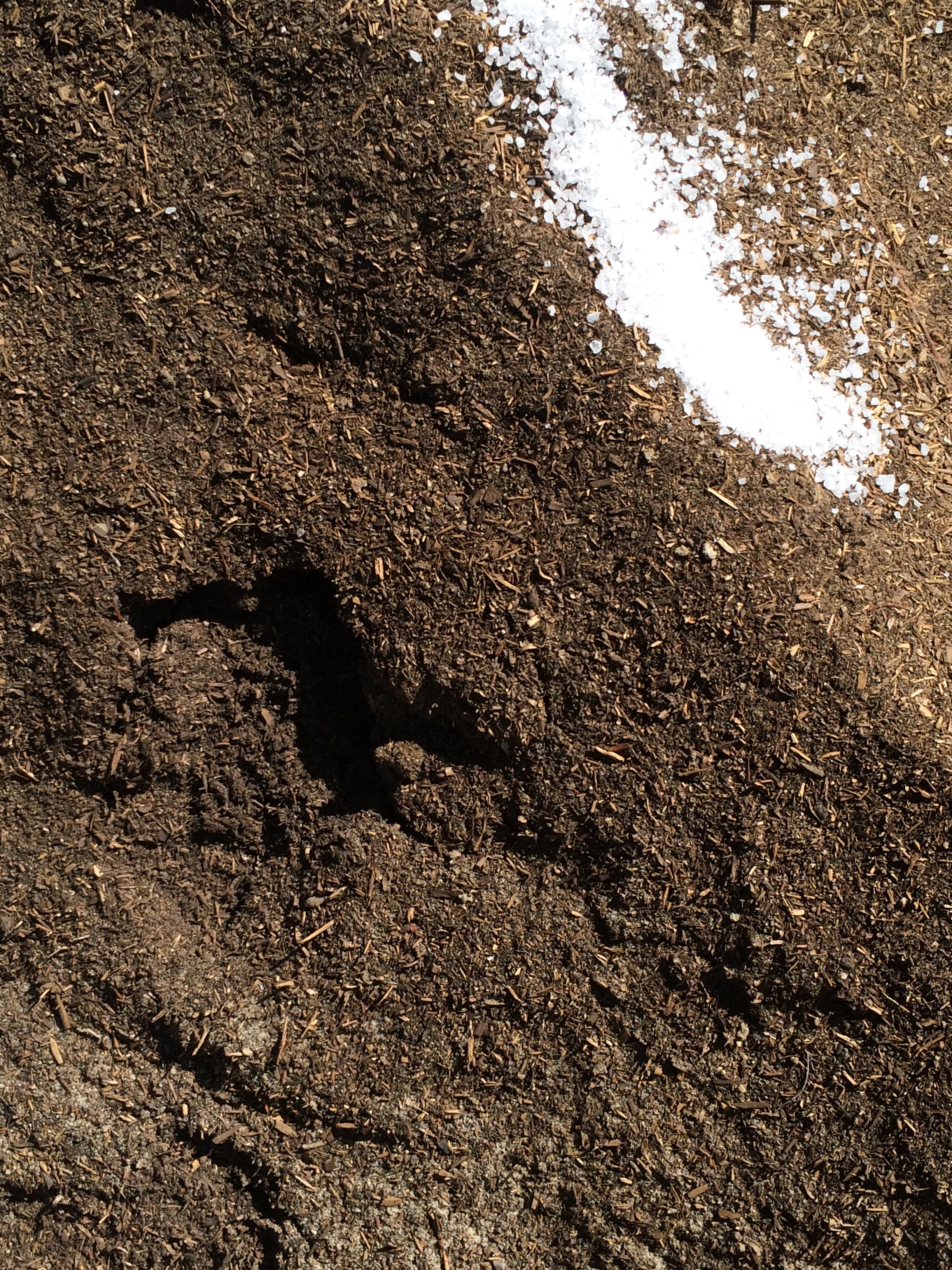
Physically indented with impressions of personal items from the 1986 artistic pilgrimage, the pieces imbue the essence of the artist and the journey. The first two, surface treated with dirt and sawdust respectively, offset the stark white work among the three, revealing a lighter state of being.
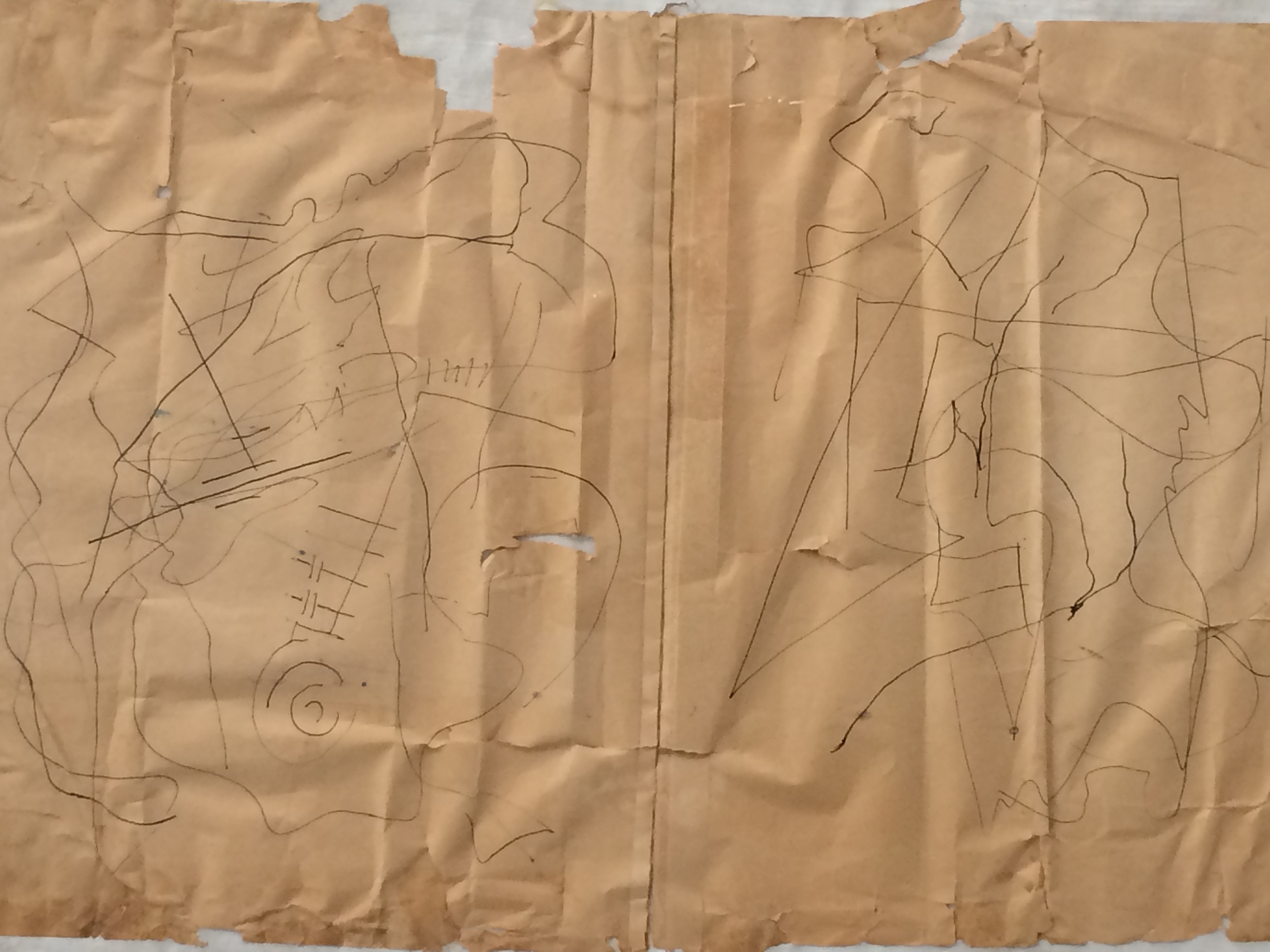
The light color palate, signaling an internal transformation, picks up again in the two, center- wall, scroll-like works on butcher paper.
The prevalent material-focused approach is further en- riched by the artist's subjective associations with white and salt. Both, tied in an amalgamated metaphor, find a place somewhere between iconography of purity, existentialism of Dos- toyevsky, and Baudelaire's evocations of vigor and rebellion of youth.
The chunks of salt in the work on the right, are ritualistically encircled in an energy containment recalling Native American practices and are balanced with a squared containment of a life-giving tree image towards the bottom. Mirrored in the left scroll, the geometric forms shift back to the use of dirt, literally grounding and settling the youthful flight back into the physicality of the self.
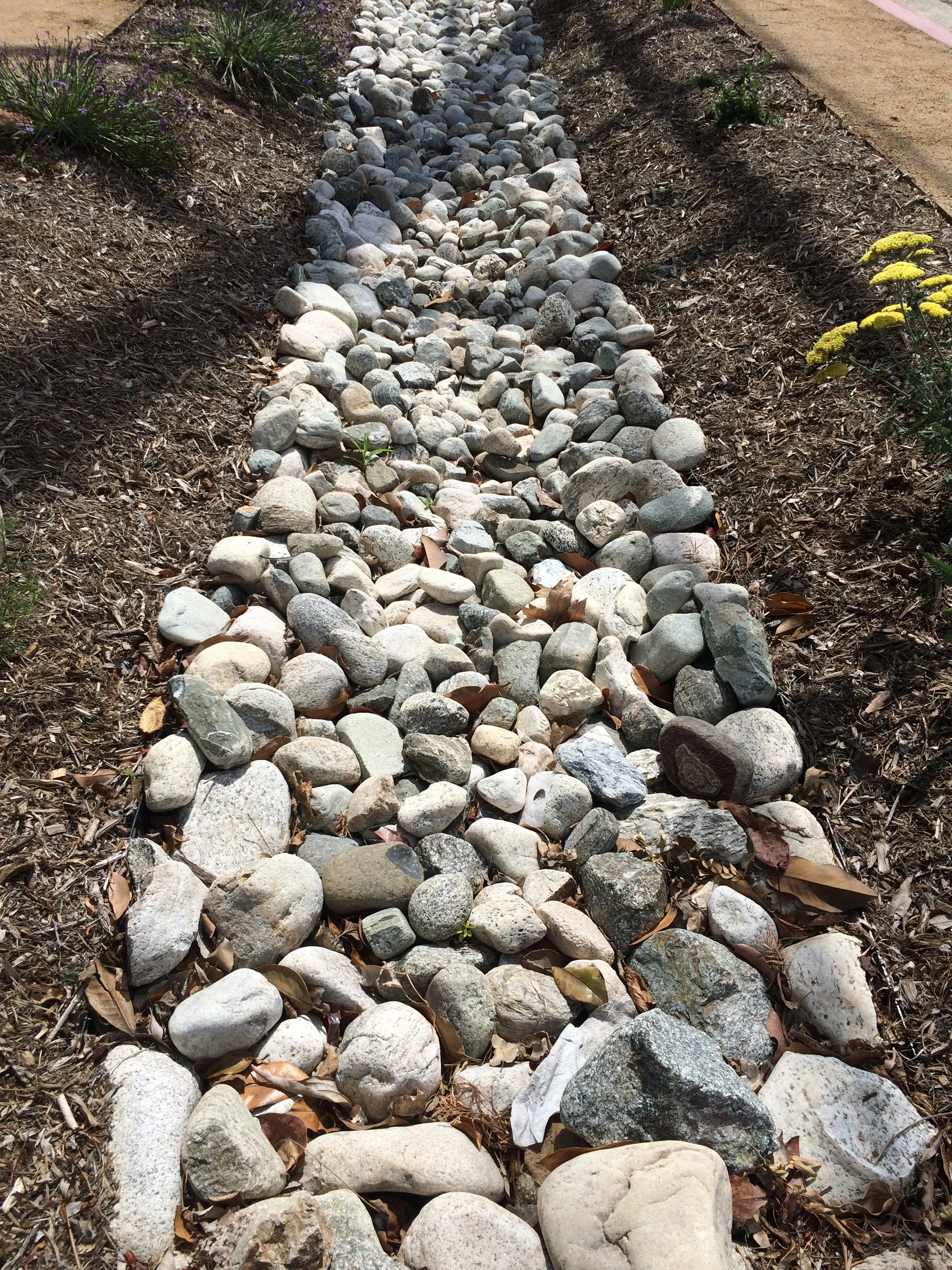
This transition tapers into an erected effigy of acknowledgment, a confirmation of the shifting states and a genuflect to the nurturing source in the "States of Earth". The altar-formed presen- tation of the stones and minerals on the seven-pillar installation, stands in recognition of the multifaceted energy and natural resources laid at the feet of humanity. Of the collection, the vol- canic rock at the heart of the installation, powerfully parallels ideas of soil's fertility with creativity of the mind and the eruption of spirited ideas.
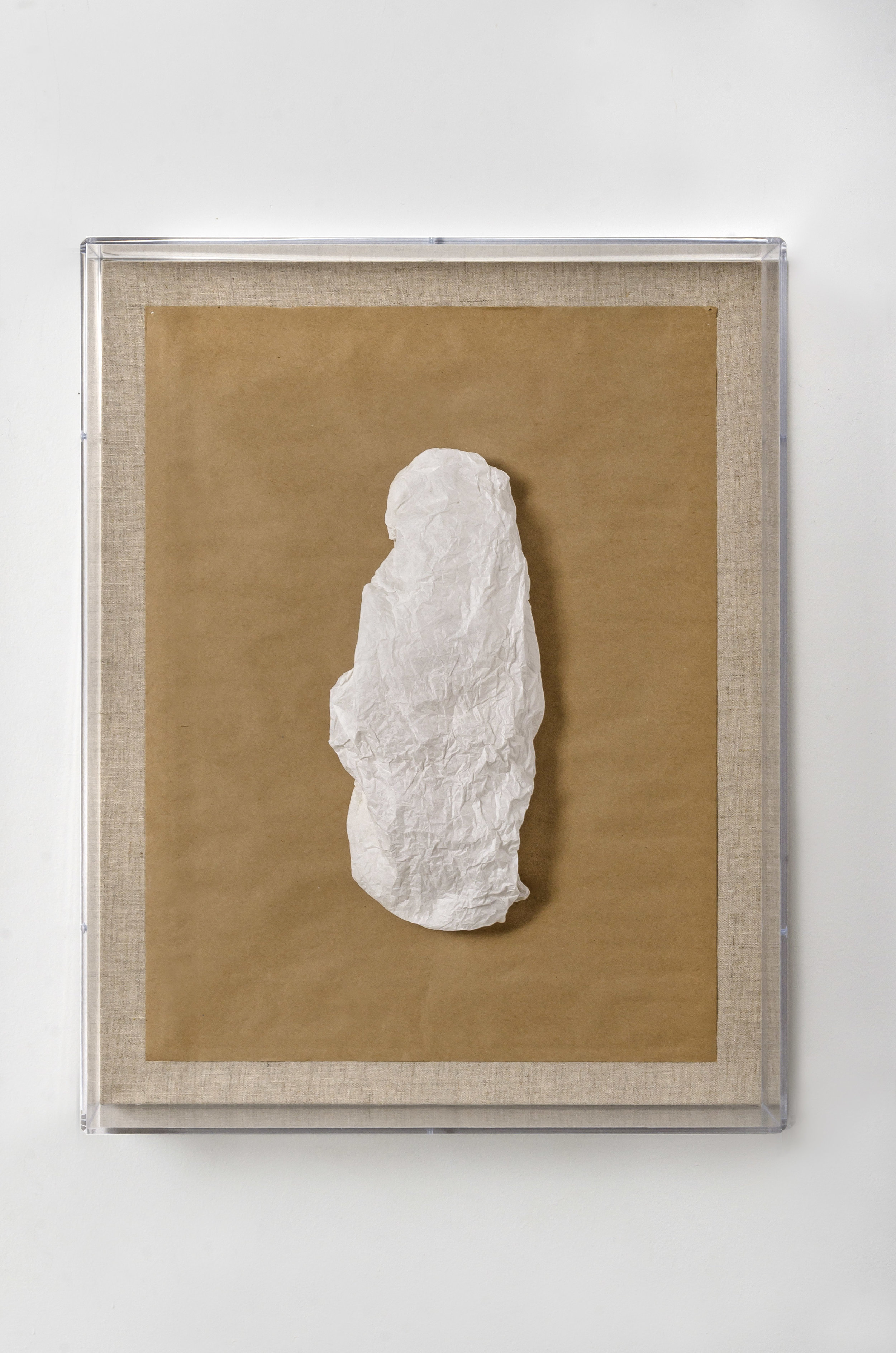
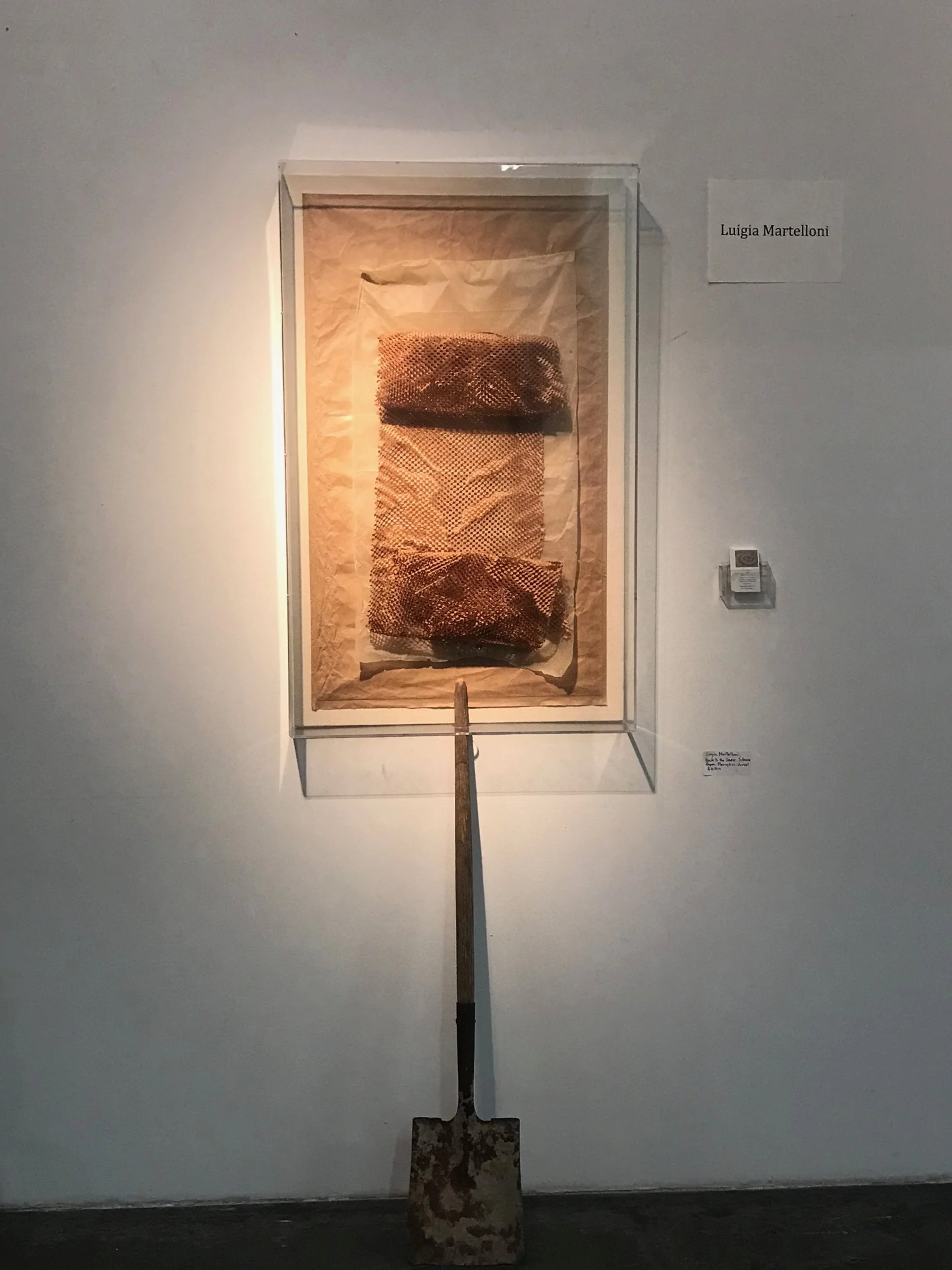
Concepts, molded into physicality through organic materials and borrowed forms, find their cul- mination in a series of latest works presented in aesthetic of assemblage along the right wall of the exhibit. Paper folios, collected over a span of time, find each other through the visualized art process of overlay and texture. At one time discarded, these salvaged pages become found- again emblems of human knowledge and innovation, building new compositions, one on top the other. Each construction, encased in a museum plexiglass display, takes on an aura of protect- ed creation of the idyllic collaborative union between nature and man. The conviction is rein- forced through implementation of salvaged agricultural tools, which, visibly worn, divulge their labors that nourish mankind.
By imploring an anti-hierarchal approach to materials, Martelloni draws a physical thread through specific core evolutionary ideas.
Interlaced along with this ideology, we find artist's personal cycles of transformation, altogether symbiotically reverberating across the exhibition's narrative. At the culmination of it, we are brought back to the origin, to earth, to salt, to the wheel - back to the place were we grasp the tautology of being.